
The community under Hellefossen
The salmon, the river and the people
For almost a thousand years, life along the Drammenselva River has been shaped by the migration of salmon. Below Hellefossen, where the river's power gathers in rapids and pools, a society grew up where nature provided both work, income and identity. The first reliable written sources about salmon fishing date from the 12th century, during the time of King Harald Gill. Even then, the fishing at Djupvik and the areas below Hellefossen was so valuable that the royal power secured ownership. This tells of a fishery of great economic importance – a fishery that laid the foundation for settlement, power and industry along the river.
Throughout the Middle Ages and into modern times, salmon fishing rights became part of the larger power structures in society. First the crown, later the church and again the state had control over the fishing. But it was the people along the river who lived with and from the salmon – fishermen, farmers, boat builders and floaters.
Advanced fishing methods were developed along the banks. Stone settings, bulwarks, nets, flakes and later nets testify to a high level of knowledge about the river's currents and the salmon's migration. Every spring and summer, people gathered at the fixed fishing spots, and the area below the waterfall became a lively meeting place where work, trade and stories went hand in hand.
The society below Hellefossen was not just about fishing. The river was also a means of transport, a workplace and a source of livelihood. Timber rafting, boats, trade and later industry grew up side by side with traditional salmon fishing. Generations of people lived their lives in rhythm with the river – with spring floods, summer fishing and autumn work.
What makes the history of Hellefossen particularly unique is its continuity. What we still see traces of today is a living tradition with roots back to the Middle Ages. The salmon brought people together, created prosperity and shaped a local community that still carries the history of the river within it.
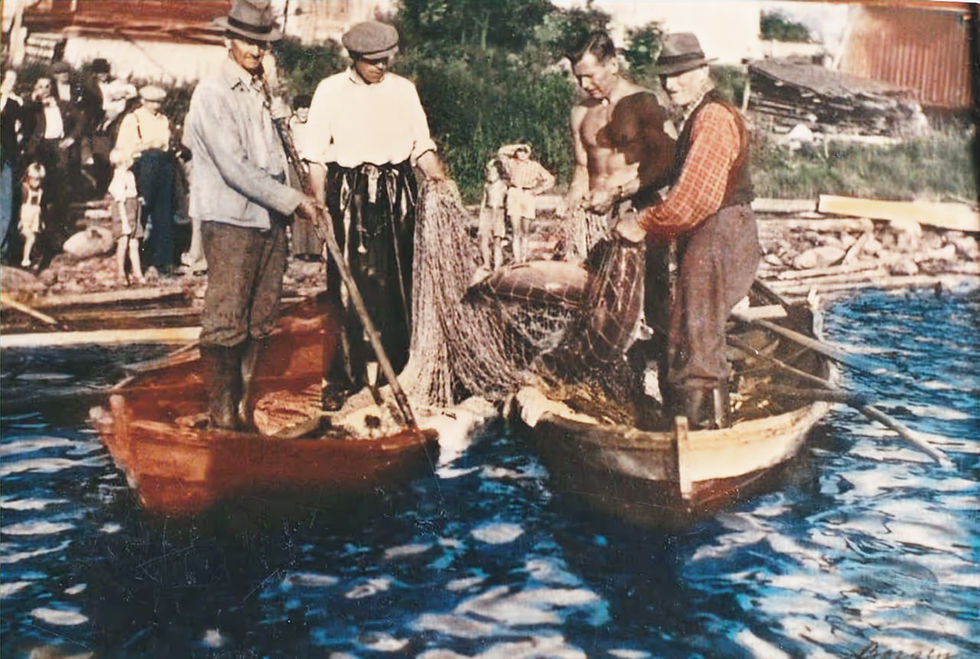
Topics that you will hear more about at this year's exhibition
The exhibition will annually show themes that describe how life was on and along the river and the society below Hellefossen. At this year's exhibition you will hear Thina Thorleifsen tell about her upbringing in Gamle-Hokksund and her meeting with Frits Thaulow in the summer of 1891. Gustav Braathen, Arne and Jon Sanden tell about the races that took place in 1860 and 1910.
![archive_file_sf0583[3].tif](https://static.wixstatic.com/media/80a19b_f70e7b7e4f964809869258e0b6fbb259~mv2.png/v1/fill/w_378,h_283,al_c,q_85,usm_0.66_1.00_0.01,enc_avif,quality_auto/arkivfil_sf0583%5B3%5D_tif.png)
The landslides and the Haga
In this year's exhibition you will hear more about three major landslides that occurred in the period 1860 to 1910. The landslides caused major material damage.
The fishing huts
Hoensbua, Ullernbua and Hobbelstadbua are three of the fishing huts that have been used by fishermen for generations.

_(7859299524).jpg)
Meeting with Thaulow in 1891
Thina Thorleifsen tells of her meeting with Thaulow in 1891. The painting Summer Evening that was painted that time are placed in Tingstua today.
The community under Hellefossen
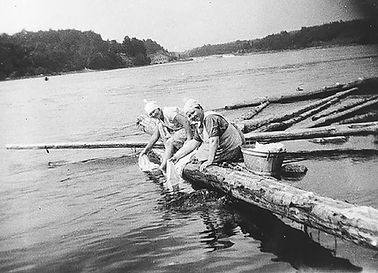
Laundry as it was done in the river about 100 years ago at Risøra. You will see a photo gallery from the early 1900s that shows pictures and the people who made up the community at that time.

The submarine boat presented in the exhibition
Thore Borgersen was the fifth generation to keep this tradition alive at the boatbuilding plant located at Loesmoen.
The boat was purchased by Arne Horne in the mid-1970s, and Harald Horgen has refurbished and carried out an extensive complete renovation of this boat that is in the exhibition.
Tore Skistad has made oars, ladles, mallets, etc.